Translate

Sunday, July 2, 2023

Mediumwave Skywave Prediction #1 - A Measurement History

Skywave propagation at mediumwave is a fascinating subject, both from a historical and technical standpoint. Radio itself has been around well more than 100 years, and broadcast radio since about 1920. As more and more stations entered the airwaves, nighttime spectral chaos ensued. How was it all sorted out? Who took charge of all this? How did we arrive at the calculations necessary to ensure that the thousands of radio stations transmitting didn't interfere with each other? What exactly goes into calculating a nighttime skywave signal strength for a distant medium wave station?

In the series:


Let's try to answer these questions in this series. We'll cover the history in the first couple of articles, then dive into the technical in subsequent articles. Throughout this series, the LF and MF abbreviations, when used, refer to the longwave frequency (LF) and mediumwave frequency (MF) bands. Note that these articles discuss mediumwave skywave prediction only.

THE LEAD-UP

At the end of World War I, a fierce battle ensued between the US government and the Department of the Navy over control of the airwaves. The Department of Commerce eventually won and became master of the air and the regulatory agency for commercial radio here in the US. They started by establishing two broadcast frequencies: 833 kHz (360 meters) and 619 kHz (485 meters). The Federal Radio Commission took charge in 1926, lasting until 1934 when the current Federal Communications Commission was formed. By 1930, broadcast radio was on its way. Nighttime signals traversed the continent from coast to coast.

Throughout the early years of radio, interest mounted to quantitatively determine the service area of broadcast stations. Early mathematical efforts focused mainly on finding an accurate calculation for groundwave coverage. K.A. Norton of the FCC would play a major role worldwide in that effort. The intricacies of skywave would be unveiled later. You might be surprised to know that serious study of longwave and mediumwave skywave propagation didn't commence until some 12 years after the first commercial AM radio station went on the air.

EARLY MEASUREMENT EFFORTS

The earliest worldwide concerted efforts to study longwave and mediumwave skywave propagation began in 1932. The International Radio Consultative Committee (CCIR), an arm of the ITU, formed a task force in that year to study propagation at frequencies between 150 and 2000 kHz. Three measurement campaigns were carried out between 1934 and 1937 on 23 long-range propagation paths between North America and Europe, North America and South America, and Europe and South America. Measurements on 10 short paths within South America were also carried out under the administration of Argentina. Two skywave propagation curves (skywave field strength graphs ordered by frequency and distance) were drawn based on the results of these measurements. One of the curves is for paths far away from Earth’s magnetic poles (north-south curve), while the other curve is for paths which approach Earth’s magnetic poles (east-west curve). The two curves were formally adopted at the 1938 International Radio Conference in Cairo and are known as the Cairo curves. They have survived, with modification in one form or another, to this day.

Click any image for the bigger picture.


The Cairo Curve Measurement Campaign


The Federal Communications Commission (FCC) of the United States carried out a skywave field strength measurement program in the spring of 1935 to derive a new set of curves for North America. At that time, there were eight clear channel stations. Nighttime signals of these stations were monitored at 11 receiving sites located in different parts of the United States. The curve corresponding to the annual median value (the signal level expected to be exceeded at least 50% of the time) was used to determine a station's coverage area, while the curve corresponding to the upper decile value (the signal level expected to be exceeded at least 10% of the time) was used to calculate the interference levels among co-channel stations. Characteristically, the 10% level is the higher signal level. These curves became part of the rules and regulations of the FCC and were adopted by the 1950 North American Regional Broadcasting Agreement (NARBA) for official use in the North American Region, which comprised the following areas: Bahama Islands, Canada, Cuba, Dominican Republic, Haiti, Jamaica, Mexico, and the United States. This method was eventually adopted with minor modifications for applications in all of ITU Region 2. It would not survive the millennium.

The FCC, knowing the clear channel curves had certain limitations (the curves do not take into consideration the effect of latitude and the proximity to the geomagnetic pole), initiated a long-term large-scale measurement program in 1939 to collect measurements from more than 40 propagation paths. The measurement program lasted for about one full sunspot cycle; in four cases it lasted for two cycles and ended in 1958. Frequencies of these paths ranged from 540 to 1530 kHz. Path lengths ranged from 322 to 4176 km. Mid-point geomagnetic latitudes (the signal reflection point between transmitter and receiver relative to geomagnetic north) ranged from 45 degrees to 56 degrees north, a narrow range of 11 degrees, although some paths from lower latitudes were later added. More about geomagnetic latitude later in the series.


THE ITU

I'll side-track for a minute and tell you about the ITU, the International Telecommunication Union, and how regions are defined. Today the ITU is a specialized agency of the United Nations responsible for many matters related to information and communication technologies. It was established on May 7, 1865 as the International Telegraph Union, making it the first international organization. The ITU has divided up the planet into three regions. Region 1 comprises Europe, Africa, the entire former USSR, Mongolia, and the Middle East west of the Persian Gulf, including Turkey and Iraq. Region 3 contains most of non-former USSR, Asia east of and including Iran, and most of Australasia. Region 2 covers the Americas including Greenland, and some of the eastern Pacific Islands.

MID-CENTURY EFFORTS

Back to our history.

The Canadian Department of Transportation took path measurements in 1947, a year of maximum sunspot number and minimum field strengths.

The EBU, the European Broadcasting Union, carried out an extensive measurement campaign from from 1952 to 1960 for paths in western Europe. A controversial field strength prediction method was developed by Ebert in 1962. In this method, empirical relationships were derived for the effects of solar activity, the influence of magnetic field, frequency, and other factors. The Ebert method cannot be considered a success because it displayed a strong tendency to grossly underestimate field strength levels, sometimes by 30 dB. It was soon abandoned. Although the Ebert method was not a success, the importance of the EBU measurements cannot be overlooked. 

Three international organizations, the EBU among them, in 1963 and 1964 set up 7 receiving locations on the continent of Africa and did studies of propagation paths from two transmitters on Ascension Island. One phase of the project was to study polarization coupling loss and sea gain. Germany also conducted measurements at Tsumeb, southwest Africa. Altogether, the African measurement campaign involved 15 receiving sites, and data from 33 paths was documented. Frequencies ranged from 164 kHz to 1484 kHz. Distances ranged from 550 km to 7540 km. Mid-point geomagnetic latitudes ranged from 29 degrees south to 40.2 degrees north. Of these 33 paths, three were from Europe to Africa.

In the late 1960s and early 1970s a number of administrations and scientific organizations made valuable contributions. The EBU reactivated its efforts and collected data from more than 30 propagation paths; many of these are intercontinental paths. In Eastern Europe, the International Organization of Radio and Television (OIRT) contributed data from 12 short intra-European paths between 600 and 1400 km at frequencies between 164 and 1554 kHz. The former USSR also collected a significant amount of measurements. A summary of their results and a proposed new calculation method was published in 1972.


THE 1974-1975 ITU GENEVA REGULATORY CONFERENCE

The big one, perhaps the biggest ever. The ITU's Regional Administrative LF/MF Broadcasting Conferences were held in Geneva, Switzerland for Regions 1 and 3. This was a major deal on several fronts. Channel spacing was to be decided on, worldwide. It was 1975!!! Also signal strength calculation standards were to be fixed and tailored by region and sub-region. Asian countries, particularly China, preferred the Cairo north-south curves. Australia and New Zealand believed neither method was adequate for their applications. They believed field strength levels in their part of the world are stronger than those observed in other places. Finally, a compromise was reached.

It was decided that the USSR method was to be used for Region 1. The Cairo north-south curve was to be used for the northern part of Region 3 (east Asia). For the southern part of Region 3 (Oceania) the modified USSR method was to be used with a correction factor of 2.7 dB added to the basic formula. Sea gain and polarization coupling loss terms were to be included whenever applicable. The propagation issue was a lesser concern compared to the channel-spacing issue. The conference was deadlocked for a number of weeks over two separate proposals: 8 kHz versus the traditional 10 kHz separation. Finally, a compromise of 9 kHz was adopted which became effective in November of 1978 for Regions 1 and 3.

In the meantime, the interference situation in South America was going from bad to worse, mainly because of the lack of any regional agreement, although some bilateral agreements were in existence. The situation in North America was somewhat better, thanks in part to the 1950 NARBA agreement.

After the ITU's LF/MF conference for Regions 1 and 3 was over, a number of administrations in South America petitioned the ITU to convene a regional conference involving all countries in ITU Region 2, the Americas. Consequently, two sessions took place. The first session dealt with technical matters and took place in 1980 in Buenos Aires. The second session dealt with the actual planning and took place in 1981 in Rio de Janeiro. The FCC clear channel curve was adopted for use in the entire region. It was also decided that sea gain and polarization coupling loss terms were not to be included in the calculations. At the first session, channel spacing was a very hot topic. The United States was in favor of 9 kHz (for all of South America), while Argentina and Canada were strongly against it. At the second session, the United States withdrew its proposal, and 10 kHz spacing was quickly agreed upon. It should be mentioned that in Region 2, longwave is not used for broadcasting. Therefore the 1980-1981 conference dealt with mediumwave only (535 kHz to 1605 kHz).

ONWARD TO THE MILLENNIUM

The CCIR Documents of the 1978 Kyoto Assembly further modified the 1974 sky-wave field strength prediction method for MF (150 to 1600 kHz) and recommended its provisional use worldwide. Several sky-wave field strength prediction methods proposed for various parts of the world also were described. 

They are:

1) Cairo North-South curve adopted for use in Asian part of Region 3 - mathematical approximation presented.

2) EBU method to be used in European Broadcasting Area with separate formula for distances less than 300 km.

3) USSR method - valid between 37° and 60° geomagnetic latitude for distances up to 6000 km and has no frequency dependence.

4) UK method - valid for all distances worldwide except for the auroral zones and has no frequency dependence.

5) Region 2 would use the FCC's method. The Wang 1977 method (Wang was a newly-hired and brilliant engineer at the FCC) was given as an alternative method for use in Region 2.

In 1979 Wang proposed a modification of the CCIR Kyoto 1978 worldwide method to improve accuracy in Region 2. Also in the same year, the Inter-American Conference on Telecommunications extended the FCC median signal level curve to distances beyond 4300 km using the Cairo North-South Curve and recommended its adoption for Region 2.

In response to Region 2 countries' request for more frequencies for broadcasting, the 1979 World Administrative Radio Conference (WARC-79, held in Geneva) of the ITU allocated the band 1605-1705 kHz for broadcasting in Region 2 only. Two sessions of regional conference took place in 1986 (Geneva) and 1988 (Rio de Janeiro) for the planning of the use of this expanded band in Region 2. It should be noted that this band is used by other services in Regions 1 and 3.

In preparation for the use of the expanded band and recognizing the need for additional data, particularly data from low and high latitude areas, the FCC initiated two separate projects in the early 1980s. In 1980, the FCC and the Institute for Telecommunication Sciences (ITS) of the Department of Commerce jointly began to collect low-latitude data at two receiving sites: Kingsville, Texas, and Cabo Rojo, Puerto Rico. The FCC-ITS efforts in low-latitude areas were supplemented by Brazil and Mexico; both administrations also collected a significant amount of data from low-latitude areas. In 1981, the FCC started a joint project with the Geophysical Institute, University of Alaska. The Alaskan project concentrated on high latitude data and lasted for five years, collecting data representing different levels of solar activity.

Administrations in the Region 3 area, Australasia, in cooperation with the Asian-Pacific Broadcasting Union, were equally active and productive in their path testing. In the northern part of this region, data from 84 paths had been documented by 1981. Australia and New Zealand jointly collected data from 85 paths. The Japanese administration had carried out a series of mobile experiments in the Pacific by 1987.

By the year 2000, measurements from more than 400 propagation paths had been documented. Great circle lengths of these paths ranged from 290 to 11,890 km. Signals of the few very short paths were verified to be skywaves. Frequencies ranged from 164 kHz to 1610 kHz. Control-point geomagnetic latitudes ranged from 46.2 south to 63.8 north geomagnetic latitude. A large amount of literature had been generated. By this time, largely the work of the ITU in setting standards and regulations for the longwave and mediumwave bands was finished. Fine tuning of the skywave calculation formulas was left to the scientists.

In the next part of this series, we'll wrap up the history and then go on to explore elementary skywave prediction and what is involved in solving it.


ITU Regions


Information for these articles has been gathered from the following resources:

An Objective Evaluation of Available LF/MF Skywave Propagation Models
John C.H. Wang
Radio Science, Volume 34, Number 3
May-June 1999

NTIA Report 99-368
Medium Frequency Propagation Prediction Techniques and Antenna Modeling 
for Intelligent Transportation Systems (ITS) Broadcast Applications
Nicholas DeMinco
US DEPARTMENT OF COMMERCE
August 1999

International Telecommunication Union Handbook
The Ionosphere and its Effects on Radiowave Propagation
Radio Communication Bureau 1998

Code of Federal Regulations Title 47
Radio Broadcast Services (FCC)
47 CFR Part 73

Prediction of sky-wave field strength at frequencies between about 150 and 1700 kHz
RECOMMENDATION ITU-R  P.1147-4
1995-2007

FCC Standard AM Broadcast Technical Standards
   ...notes and changes to 47 CFR Part 73
Broadcast Service Bureau
Filed January 20, 1987

Medium Frequency Propagation: a survey
P. Knight
BBC Research Department 1983/5
May 1983

NTIA-Report-80-42
Comparison of Available Methods for Predicting Medium Frequency 
Sky-Wave Field Strengths
Margo PoKempner
US DEPARTMENT OF COMMERCE
June 1980

LF AND MF SKY-WAVE PROPAGATION: the origin of the Cairo curves
P. Knight
BBC Research Department 1977/42
November 1977

Friday, June 9, 2023

The Fascinating Beverage Antenna Patent

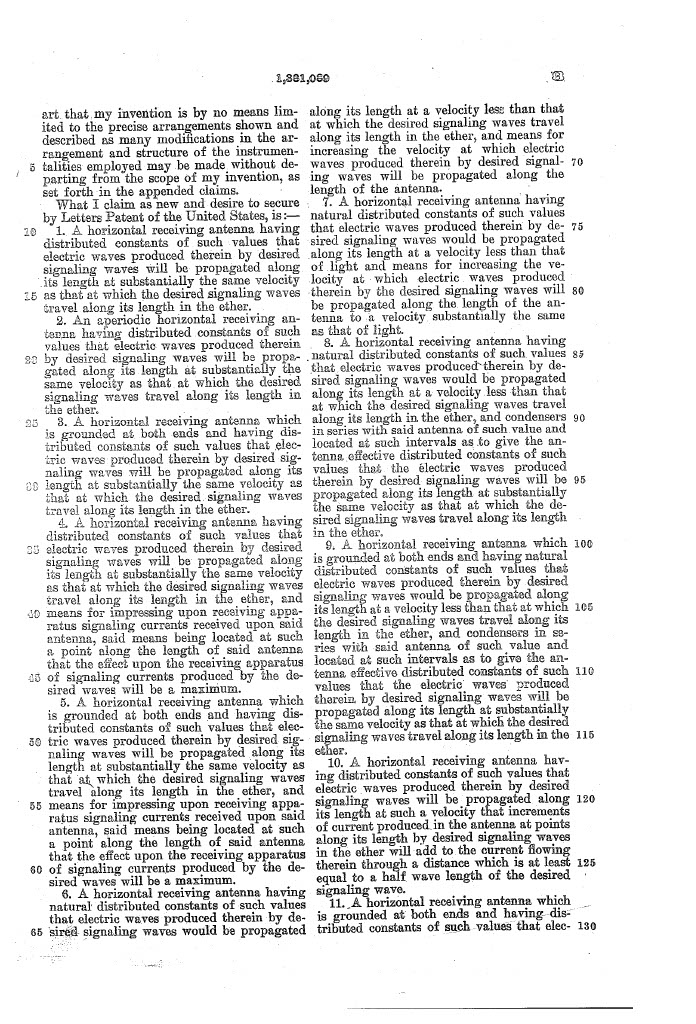
April 8, 1920

"To all whom it may concern:"

"Be it known that I, HAROLD. H. BEVERAGE, a citizen of the United States, residing at Schenectady, in the county of Schenectady, State of New York, have invented certain new and useful Improvements in Radio Receiving Systems, of which the following is a specification.

My present invention relates to radio receiving systems and more particularly to an improved arrangement of an antenna for receiving purposes.

The object of my invention is to provide a receiving antenna which will have highly directive properties, which will be very efficient in its operation and which will also be highly selective.

In carrying my invention into effect I make use of a horizontal preferably aperiodic antenna extending in a direction parallel to the direction of transmission of the signals to be received.

This antenna is constructed with distributed capacity inductance and resistance of Such values that the currents produced therein by the desired signals increase progressively from the end of the antenna nearest the transmitting station be coming in the preferred case, the maximum at the end farthest from the transmitting station."

Thus starts the patent application of one Harold H. Beverage for his famous "Beverage" antenna. Filed with the U.S. Patent Office, April 8, 1920. Approved June 7, 1921. Patent #1381089. Just imagine, radio was in its infancy in 1920 and along comes this marvelous antenna, the Beverage.

The Beverage antenna, patented by Harold H. Beverage, is a type of longwire antenna used for radio communication, specifically receiving. It is named after its inventor and is known for its simplicity and effectiveness in receiving weak signals. The antenna consists of a single wire, usually several wavelengths long, which is suspended a short distance above the ground.

The Beverage antenna is typically oriented in a specific direction to optimize its reception capabilities. It is commonly used for receiving high-frequency signals, such as those in the shortwave and mediumwave bands. The long length of the wire allows for enhanced directivity and low-angle radiation, which makes it particularly suitable for long-distance communications.

One of the main advantages of the Beverage antenna is its ability to reduce noise and interference from unwanted directions. By carefully selecting the orientation and placement of the wire, it is possible to maximize signal reception from the desired direction while minimizing signals coming from other directions. This makes the Beverage antenna valuable for receiving weak or distant signals in environments with high levels of electromagnetic interference.

Harold H. Beverage patented the design of this antenna in the year 1920-21, and it has been widely used by radio enthusiasts, amateur radio operators, and professionals ever since. The Beverage antenna remains a popular choice for those seeking long-range reception and reliable signal quality. Just below, have a look at the original H.H. Beverage patent filing. It makes for interesting reading.

Click on any to enlarge.


Thursday, May 18, 2023

A Review Of The XHData D-109 DSP Radio

Next up, let's talk about the new XHData D-109 DSP radio. I ordered one from Amazon last week and it came over the weekend. It was just over $30 with free shipping from XHData using Amazon Prime.

The D-109 is a beautiful little radio, slightly larger in height and width than XHData's analog DSP radio, the D-219. It measures out at 6 inches wide, 3-1/4 inches high, and 1-1/4 inches thick. It is quite a bit larger than the RadiWow R-108.


XHData D-109

Full coverage of mediumwave is available - 520 to 1710 kHz. All AM bandwidths are available - 1,2,3,4,6 kHz. It tunes in 1 kHz steps. The radio also covers the longwave band. It came pre-activated on my radio, but may be disabled if you wish. Shortwave coverage is complete, from 1711 kHz to 29999 kHz. FM coverage ranges from 64 to 108 mHz, seemingly all in one band.

Fit and finish is good. The sound from the front-facing speaker is very pleasant, as others have stated. Two watts of audio are available. It has impressive battery life with the lithium 18650, 2000 mAh battery. I've been running it using the speaker for several hours per day for nearly a week, and the battery still shows a full charge. Charging is through a typical USB cable plugged to a 5 volt source. The XHData designers have used a USB-C style connector, a bonus.

I found the tuning knob is a little small, but adequate. Frequency entry on the keypad is direct and immediate, like the Tecsuns have, nice. No extra buttons to press. Keys are robust and click with a tactile snap, and feel like they'd last a long time. The display is backlit with a nice soft golden yellow color. The display is crisp and clear, but otherwise typical for a digital DSP radio. It shows battery charge, clock time, alarm times, temperature, and receive RSSI (in the typical dBµV) and SNR (signal-to-noise) levels.

The radio has a clock, two alarms, and a sleep function. A scan function scans any band of interest quite nicely. Plenty of memories are available for those who use them. 100 each for FM, longwave, and mediumwave, 300 for shortwave.

The radio supports bluetooth and can be used to play audio from an external device through its bluetooth connection. It also sports a TF card slot for a micro SD card, which can be loaded with music and played through the radio's audio system. Allowed formats are: MP3, WMA, WAV, and FLAC. Recording of received station's audio is not possible, unfortunately. At least as far as I can tell.

For mediumwave, the 10/9 kHz channel step choice is easily set by holding down the 2 key for a couple of seconds when the radio is off. Tuning is interesting. The radio seems to be locked at a 1 kHz tuning rate (10 kHz for FM) unless you rotate the tuning dial quickly, which then goes into fast tune and steps at 10 (or 9) kHz (mediumwave) or 5 kHz (shortwave) or 100 kHz (FM). For example, on mediumwave, tuning slowly tunes as such...  the frequency changes: 620..621..622..623..624..625..jump to 630. They've elected to advance to the next channel when you pass the 5 kHz halfway point. There are channel up/down buttons too. The channel up/down buttons only step up or down 1 kHz at a time, and no convenient channel jump at the 5 kHz halfway point. I feel it would have been better for channel up/down to advance at the user's chosen 9 or 10 kHz step and not 1 kHz. Maybe someone has figured out something which circumvents this.

Mediumwave sensitivity is exceptional. I did some signal strength comparisons with the R-108 and it is identical, or better. Even the RSSI (dBµV) readings are within one or two dB. It is more sensitive than my larger old school analog Tecsun R-9700DX, slightly better than my D-219 DSP analog, way better than my Sangean SR-35 and Dreamsky DSP analogs. In fact, it holds its own against my PL-880 and Sangean ATS-909X. That's impressive. Now comes the problem.

Shortwave is the problem. Maybe not a fair test here, as I am within 1.5 miles of two 5000 watt stations. I am bathed in more than 200 mV/m from each of those stations, 266 mV/m from one. Those are truly clobbering signals, 1/4 of a volt per meter. My SDRs can barely handle it. Intermod and overload on shortwave coming from the mediumwave band, particularly between 2-8 mHz, basically makes shortwave unusable for me at this location. An initial trial in the country about 4.5 miles from a 20 KW transmitter had a similar negative result. I need to take this radio well out into the country, far from mediumwave transmitters, and see if that makes a difference.

I was convinced I could remedy this but could not. I plugged in an external antenna, running the coax feed through a 30 dB (attenuation) RTL-SDR broadcast AM Reject filter in series with an old Grove TUN-4 preselector for the shortwave bands. It did not work, in fact it was worse. Experimenting with a shorted piece of coax with no antenna connected, I discovered that part of the problem is that mediumwave signals are somehow being funneled into the radio via the antenna ground (the coax shield). The longer the shorted piece of coax got, the worse was the intermod. More experimenting is yet to come. Shortwave above 41 meters is a little better, but still hit and miss, though when I was able to null the mediumwave interference a bit, shortwave sensitivity seemed good.

The whip antenna on the D-109 is 21 inches in length like its analog cousin, the D-219. Warning, don't do this! I removed the whip antenna by unscrewing the bottom mounting screw, and pulled the whip from the radio. Unfortunately XHData in their design wisdom have decided to solder a connecting wire directly to the bottom of this screw, and the wire broke off. There is no fixing this unless you pull the case apart, a nasty job on this radio, affirmed by Gary DeBock in his teardown of the D-109.

The radio works wonderfully on MW with an 18 inch tuned box loop. The sensitivity, already very good, is outstanding when coupled to the loop.

Bottom line so far: Great radio for mediumwave. I'm not an FM fan, so no FM testing was done. If you want something for shortwave, you had better be sure you live in a rural area away from high power AM stations. $30 seems a good price point for this radio. It's a keeper for me, and has become my morning driver radio.


Tuesday, May 16, 2023

Notes On The XHData D-219 Analog DSP Radio

My D-219 came a couple of weeks ago and I've been checking it out. A fair amount of discussion has ensued about this radio, and I think feelings about it are generally positive. It is an analog DSP radio, using the Silicon labs Si4825 DSP chip. That to say, the tuning "mimics" the analog tuning of old school radios, but uses digital technology to do it. Amazon had it on sale for about $12, so I jumped at the chance to try it out.

The XHData D-219

The fit and finish on this radio is very nice for a $12 radio. The tuning wheel tunes butter-smooth with no noticeable backlash, better by far than many. The radio measures 3 inches tall, 1-1/8 thick, and 5-3/16 inch wide, just about 1/2 inch wider than the RadiWow R-108. The whip antenna is 21 inches long as opposed to the 19 inch whip on the RadiWow R-108. The radio takes two AA cell batteries and they last admirably, even with the speaker engaged. It presumably will use rechargeables as well. A 5 volt adapter plug is at the top of the radio next to the headphone jack. A stereo headphone jack is also at the top (only mono delivered), right next to the radio's sliding ON-OFF switch. On the right side are the tuning wheel and volume control. A crisp, well marked dial scale faces frontward and beneath it is the sliding band switch, similar to those found on other inexpensive analog radios. The band switch looks and feels more robust than others I've owned. A nice hand strap also come with the unit. An English manual is provided, describing minimally how to use the radio.

The radio tunes mediumwave, shortwave, and the FM band. Note that this radio is made predominintly for the Asian markets. It only tunes mediumwave from 522 to 1620 kHz, and that at only 9 kHz channel steps, used outside of the western hemisphere. Two FM ranges are present - 64 to 87 mHz, and 87 to 108 mHz. There are nine shortwave bands, covering broadcast segments from 4.75 mHz to 22.0 mHz.

The following comments refer to the mediumwave band. In particular, I'll discuss the tuning quirks of this radio. I have other analog DSP portables which tune similarly.

I'm impressed by the mediumwave sensitivity, it's very good. Examples: On weak daytime signals, it was better than my other DSP analogs, the Sangean SR-35 and the inexpensive ($13) Dreamsky pocket portable. It was better than old school analog Sony ICF-S10MKII. Against the old school Tecsun R-9700DX, a much larger radio with longer loopstick, it was no match of course. It wasn't quite up to par in sensitivity with the DSP all digital RadiWow R-108, but close.

Tuning is interesting to say the least, pitting a 9 kHz channel step against a 10 kHz band, and the already existing tuning wonkiness of these analog DSP chips. Daytime tuning may seem pretty normal. Nighttime is a different story. On moderate to strong stations, there may be three, five and sometimes even seven tuning peaks as you tune through a signal. This to me suggests a wide AFC (automatic frequency control) bandwidth in signal selection, possibly up to 27 kHz (3 channel steps) either side of the actual tuned center.

Note that these analog DSP radios don't use a traditional stepped tuning encoder. They are tuned with a simple 100K ohm (the SiLabs versions) or 10K ohm (most Chinese chip versions) potentiometer. The chip reads a voltage across the potentiometer and determines the tuned frequency from that. Software then decides what to do thereafter.

Checking the software manual for the Si4825 chip, one encounters the UNI-AM software switch on the DSP chip, named for "Universal AM". This is likely what is used to defeat the normal default AFC range of 1.1 kHz. I don't see the extreme 3/5/7 peak characteristic in the Sangean SR-35 or the Dreamsky. Each peak as you tune off signal center is reduced in audio by a couple of dB, mimicking the analog tuning of old. It is apparent that a signal's strength needs to be above a certain threshold to engage this multi-step tuning curve. Weak signals won't engage it. To-wit, a signal above this threshold is essentially "captured", forcing the tuning to its channel. This presents a problem in trying for weak stations between stronger channels.

See the example chart just below. I'll describe a typical experience in tuning this radio at night where many signals at varied strengths are present.

9kHz Offset Station we are trying for
---- ------ -----------------------------------------
612  2 kHz  610 WTEL Philadelphia, PA (medium strong)
621  1 kHz  620 WSYR Syracuse, NY (very weak)
630  0 kHz  630 CFCO Chatham, Ontario (medium strong)
639  1 kHz  640 WNNZ Westfield, MA (weak)
648  2 kHz  650 WSM Nashville, TN (very strong)

My listening post is in western NY near Rochester, about 75 airline miles west of Syracuse. With the D-219, catching WSYR-620 or WNNZ-640 in Massachusetts is hit and miss. This is because they are sandwiched on either side and between two much stronger signals. The stronger signals engage the 3/5/7 step tuning algorithm.

Example: In this 610-650 kHz range, WSM-650 was the strongest of all during this test. I centered WSM-650 for strongest audio, approaching from a higher frequency. This will occur at 648 kHz on this radio. Tune left one peak, and WSM's audio reduces by a couple of dB. Tune left again and WSM's audio reduces again a couple of dB. After two tuning steps, we should be tuned to 630 kHz, but the radio is still tuned to 650 kHz due to the AFC capture effect. Tune one more step to the left (621 kHz actual), and suddenly the radio tunes to CFCO-630. Why? AFC capture effect again. We have skipped over WNNZ-640 because it is extremely weak and below the capture threshold. The same for 620 WSYR, the station we should be tuned to - too weak. And since WSM at 650 kHz was the strongest signal, stronger than CFCO, when we were actually tuned to 630 kHz, the radio remained on WSM (648 kHz actual, with audio reduced). Important!!! - the tuning direction is important here - we are tuning downward and off the strongest signal, we are not approaching the strongest signal. More about this phenomonym explained below.

Turning the radio off, then on, sometimes has an interesting effect. In the above situation where we landed on CFCO-630 coming from 650 WSM, turning the radio off then back on may indeed land you on 620 kHz!!

In another case of downward tuning, where CFCO at 630 kHz was in a deep fade and virtually non-existent signals at 620 and 640 kHz, tuning progressed from WSM-650 directly to WTEL-610, bypassing 630 CFCO. Nothing was heard in between. It was the capture effect at work again.

Notice for the above scenarios we are tuning downward in frequency. Tuning upwards from 612 kHz will have a different result because we are approaching adjacent channels from a different direction and adjacent channel signal pair strengths will differ, with the strong signals capturing first if above the software-set threshold.

On old school, traditional analog radios it was fairly easy to figure out what frequency you are tuned to. We'd go to a known channel and count the channel "bumps" as you tuned up or down. It's not totally possible with the DSP analogs, at least the D-219. AFC capture may force-tune to a stronger channel one, two, or three steps away.

This is where a passive loop or helper antenna might benefit this radio, by increasing signal strengths of weaker channels so they trigger the AFC to capture. Care should be taken not to overload the radio with too much signal. My 18 inch passive, tuned loop is too much for this radio. Possibly a 12 inch passive loop might not overload. My testing a few years ago showed that a 12 inch loop was roughly equivalent to an 8 inch ferrite coil. It will provide plenty of signal.

Shortwave is a problem with this radio if you are in a high signal area near one or more mediumwave transmitters. Intermod and overload bleed through is severe throughout the shortwave spectrum. I am unable to test this radio on shortwave anywhere near the city of Rochester because of it. My next trip to the country I'll do that. I'm not an FM fan, so no FM testing was done.

All-in-all, I like this radio quite a bit. It has a great amount of what I like to call "fun factor". Mediumwave sensitivity is good and better than most. If XHData decides to make a 10 kHz step version for the North American market, I'd go for it. It's perhaps the best but least expensive radio I've bought.

EXTRA - MORE DISCUSSION ABOUT ANALOG DSP TUNING AND THE XHDATA D-219

I've studied the software manuals in pretty good detail for these analog chips and also the digital ones. Here's what I have gleaned from them.

Document AN610.pdf covers the American SiLabs 48xx analog chips. Asian clones of the DSP chip are slightly different in their operation. I hesitate to use the word "clones", as the Asian chips have a few more bells and whistles than the SiLabs ones. To our advantage, I might add.

AMERICAN SILABS CHIPS:

Channel step size (9 or 10 kHz) is set by software at power on time.

AN610.pdf:

"3. The channel spacing is configurable for the AM band mode only. System controller can select between 9 (9 kHz) and 10 (10 kHz) channel space. Note: SW is set to 5 (5 kHz) by default, FM to 100 kHz."

The document does not indicate that any other value can be set, other than 9 or 10 if in AM band mode.

The analog tuned DSP chips don't have a traditional stepped tuning encoder. They tune using a 100 K ohm linear potentiometer. A voltage is impressed across the pot and when you rotate the pot knob the DSP chip reads the voltage, and from the voltage, the controller software calculates a frequency to tune to.

If we are set to a 9 kHz step, tuning proceeds to the closest 9 kHz boundary. If we are set to a 10 kHz step, tuning proceeds to the closest 10 kHz boundary.

Note: The analog CCrane Radio EP Pro has a switch on the back to select 9 or 10 kHz step. It must force the radio to go through a power up sequence to accomplish this.

Filter bandwidth for AM looks to be fixed, i.e. not able to be set at power on, probably at about 6 kHz. Remember, we are talking about the analog DSP chip here, not the 473x digital version.

The digital series chips (the 473x models like the PL-380, etc.) are tuned totally differently. Tuning (internally at the software level) is in finer graduations and by default is to 1 kHz. The user usually has control of the step size in the AM band - 1, 9, or 10 kHz. They use a regular mechanical encoder, not a potentiometer.

ASIAN ANALOG CHIPS, commonly the KT0932m, KT0936m, KT0913:

Again, step size is set by software at power on time.

The document I have on these indicates the step size can be set at not only 9 kHz or 10 kHz, but also the 1 kHz step size. The tuning mechanism is a 10 K ohm potentiometer here. The KT0913 supports up and down channel buttons, the other two do not.

Notable in the Asian documentation is the raw sensitivity of these chips is claimed to be a bit better than the SiLabs chips, by about 6 dB. 16 µV @ 26 dB signal-to-noise ratio.

Filter bandwidth for AM has some flexibility. It can be set between 1 and 5 kHz at power up. I don't see a 6 kHz filter anywhere.

The Asian equivalent to the SiLabs Si473x series is the KT0935r.

Bottom line-

If a radio uses the Asian analog DSP chip, 1 kHz step size on AM is possible if the designer sets it at power up time. American SiLabs chips can only step at 9 or 10 kHz.

An interesting YouTube video on the XHData D-219 by Todderbert can be seen here:

Todderbert D-219 Review

There is a comment by a Anna P in this video link that explains that these chips have a wide AFC and can retune the frequency when the signal was not at the center by itself. I'll paste her full explanation here, as it's an interesting read. I'm not sure I'm in total 100% agreement, but there is merit to much of what is stated. Thanks to Jay Allen for the tip on this comment.

"Anna Plojharová - I don't think you need a dedicated "10kHz"  version. These analog tuned DSPs use rather wide AFC function which retunes the radio to the exact signal it sees. It first tunes to the exact frequency corresponding to the knob position and looks for carrier there. If not found, it gradually widens the frequency range till it finds one and then retunes properly on it (tunes the antenna). If this carrier is more than half of the tunning control step away (so there is other position of the dial), it artificially reduces the volume in order to get the "correct tuning" feeling, but that is 100% artificial behavior, the real reception is tuned exactly onto that carrier found. Usually the total search range for the given dial position is way wider than channel spacing, often 30..50kHz (so +/-3..5 channels). And the artificial "detune volume reduction" is often temporary - if there is really just that single carrier, after few seconds many chips just take that as "the desired station" and bring the volume back up."

The only issue could be, if two stations are the same frequency difference from the dial position, then it becomes tricky to convince the radio to select the weaker one, there the correct tuning step does help.

Todderbert's AM bandscan shows that the radio's tuning does not automatically retune to center peak of 10 kHz station boundaries. That implies to me that a 10 kHz spacing model would be preferable and work better here in the western hemisphere.

AFC width is selectable in software (the so called "UNI-AM" parameter), but only two choices - a default value of 1.1 kHz and what they call "Universal AM Band", which is an unspecified but wider AFC width. My suspicion is if "UNI_AM" is chosen, the radio may respond well to either 9 or 10 kHz spacing. HOWEVER, important to note here, the AN-610 software document says this is only available in the Si4827 chip models. The D-219 has the 4825A, per Kelly (thanks for checking Kelly).

On my CCrane Radio EP Pro, the one with the 9-10 kHz spacing switch, if I set to 10 kHz and tune to a station, then switch the slider over to 9 kHz, the tuning is off and does not recenter. This is dramatically shown on WYSL-1040 here, a very strong station. Tuned perfectly to 1040 kHz in 10 kHz spacing mode, then switching to 9 kHz where the new closest channel would be 1044 kHz, WYSL virtually disappears as the radio is now tuned 4 kHz away from 1040 kHz. Clearly, 9 kHz spacing does not recenter to a 10 kHz boundary. The wide AFC statement clearly does not apply to all analog DSP radios.