Yesterday while checking sunrise/sunset times for a mediumwave station, I came across NOAA's (National Oceanic and Atmospheric Administration's) new solar calculator web page. It is impressive.
NOAA Solar Calculator web page
Now using the Google Maps interface, you can move a map marker over a geographic point of interest and after specifying the date and time, automatically calculate the local sunrise and sunset times for that point. The latitude and longitude coordinates can be saved to a cookie for use on a subsequent visit to the page.
Additionally, the calculator displays solar data in the form of the Equation of Time, Solar Declination, Solar Noon, Solar Elevation, and Solar Azimuth (current right ascension of the sun). The formula is highly accurate.
The old NOAA Solar Calculator is still available here.
I've added the link to the new calculator to the right sidebar above the old calculator to keep it handy. Now we have an easy and foolproof way to get sunrise/sunset data for any point of interest, and quickly. Thank you NOAA!
Translate
Saturday, February 16, 2013
Monday, February 11, 2013
Field Strength Calculator One: Update 1.0050
I tweaked the Field Strength Calculator One program a little and added some new calculations figures which may be helpful for mediumwave DXers. Added are expected distance coverage for Local (2.5 mV/m), Distant (0.5 mV/m), Fringe (0.15 mV/m), and Extreme Distance (0.05 mV/m) signal levels. Also added is a Custom mV/m level which you can enter and the program will calculate the expected distance.
For those new to Field Strength Calculator One, the program returns expected received field strength in millivolts per meter and dBu (also known as dBµV/m), based on ground conductivity, earth dielectric and several other input constants. It also displays the distance to the radio horizon and the signal path loss in dB, along with several more technical parameters. The resulting output of Field Strength Calculator One should be accurate in most cases to a couple of percent in the longwave and mediumwave bands. It compares favorably to ITU program GRWAVE and currently available FCC Ground Wave Conductivity graphs.
For further information on how field strength is calculated see the Field Strength Calculations Series previously published on RADIO-TIMETRAVELLER.
DOWNLOAD
To download, see the link at the top of the right sidebar under LATEST PROGRAMS. The sidebar at the top right will have the most current link in case the program is updated. The link will change in the case of an update, so I would avoid copying and pasting it into a forum or other web page. Come to the main page of this blog instead.
INSTALL
Install is simple. Download the .zip file and unzip. Click on the FieldStrengthCalculatorOne.exe file to run. This program makes no registry changes and saves no data to your hard drive. It has been developed and tested in Windows 7. It should work fine in Windows Vista and XP environments, and Windows 8. It is written in the old standby Visual Basic 6.
Included in the .zip is a readme.txt file. Be sure to have a look.
Click image to enlarge.
For those new to Field Strength Calculator One, the program returns expected received field strength in millivolts per meter and dBu (also known as dBµV/m), based on ground conductivity, earth dielectric and several other input constants. It also displays the distance to the radio horizon and the signal path loss in dB, along with several more technical parameters. The resulting output of Field Strength Calculator One should be accurate in most cases to a couple of percent in the longwave and mediumwave bands. It compares favorably to ITU program GRWAVE and currently available FCC Ground Wave Conductivity graphs.
For further information on how field strength is calculated see the Field Strength Calculations Series previously published on RADIO-TIMETRAVELLER.
DOWNLOAD
To download, see the link at the top of the right sidebar under LATEST PROGRAMS. The sidebar at the top right will have the most current link in case the program is updated. The link will change in the case of an update, so I would avoid copying and pasting it into a forum or other web page. Come to the main page of this blog instead.
INSTALL
Install is simple. Download the .zip file and unzip. Click on the FieldStrengthCalculatorOne.exe file to run. This program makes no registry changes and saves no data to your hard drive. It has been developed and tested in Windows 7. It should work fine in Windows Vista and XP environments, and Windows 8. It is written in the old standby Visual Basic 6.
Included in the .zip is a readme.txt file. Be sure to have a look.
Click image to enlarge.
Thursday, February 7, 2013
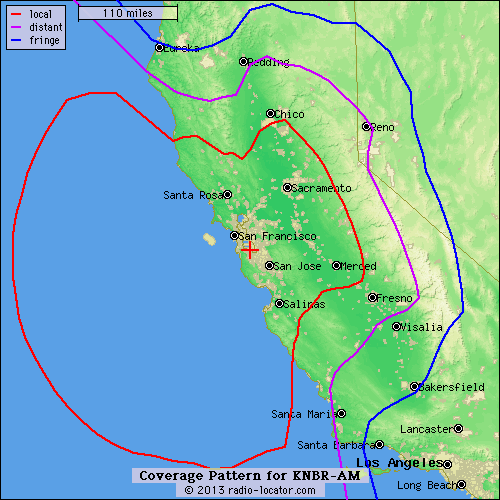
San Francisco's KNBR-680
I was up in the San Francisco Bay area for a couple of days last week. Stayed overnight in Belmont, about 20 miles south of the city, down on the peninsula. While there, I suddenly realized that I was less than a mile from the KNBR-680 transmitter site, so jumped in the truck early one morning to check out the site. The site is at the edge of a residential area, in the boggy area next to San Francisco Bay, and just south of the San Mateo - Hayward bridge (CA 92). KNBR broadcasts with a power of 50KW.
The single broadcast tower is impressive, some 550 feet tall. It is sectionalized, an FCC type 3, and is also a nice example of top-loading. The lower section is 400 feet tall, and the upper section 150 feet. With the top hat, KNBR realizes an electrical equivalent of .520 wavelength. Just feet from San Francisco Bay, its radials literally dangle in the boggy water. It's no wonder they call KNBR "The Flamethrower".
On the air since 1922, (as KPO, originally transmitting from downtown San Francisco) KNBR has had a long history. It became an affiliate of the NBC network in 1927, and was later sold to NBC and became their flagship station on the west coast. The call sign changed from KPO to KNBC in 1946 and remained until 1962 when it was changed to KNBR after the local NBC television affiliate assumed the KNBC call.
In 1987, when NBC got out of the radio business, KNBR was sold to Susquehanna Corporation, a longtime radio station operator. Currently, KNBR broadcasts a full-time sports format, and has so since 1990. KNBR is the longtime radio home of baseball's San Francisco Giants and had been affiliated with ESPN, but on January 2, 2013 became a charter affiliate of CBS Sports Radio.
KNBR "The Sports Leader" is owned by Cumulus Media Partners, LLC, a private partnership of Cumulus Media, Bain Capital, The Blackstone Group, and Thomas H. Lee Partners. It was purchased from Susquehanna in 2005 along with other Susquehanna Radio Corporation stations.
The tower site is located at latitude 37.54722222 (N) and longitude -122.23333333 (W). If you are ever in the area, be sure to check out this impressive site.
Headed home to southwestern Arizona last Tuesday, KNBR was easily logged on the truck radio while motoring through Needles, CA and into Arizona at mid-day with good signal strength, at distances exceeding 480 miles.
Note: As of this date, the FCC database still erroneously lists KNBR as being owned by the Susquehanna Radio Corporation.
The single broadcast tower is impressive, some 550 feet tall. It is sectionalized, an FCC type 3, and is also a nice example of top-loading. The lower section is 400 feet tall, and the upper section 150 feet. With the top hat, KNBR realizes an electrical equivalent of .520 wavelength. Just feet from San Francisco Bay, its radials literally dangle in the boggy water. It's no wonder they call KNBR "The Flamethrower".
On the air since 1922, (as KPO, originally transmitting from downtown San Francisco) KNBR has had a long history. It became an affiliate of the NBC network in 1927, and was later sold to NBC and became their flagship station on the west coast. The call sign changed from KPO to KNBC in 1946 and remained until 1962 when it was changed to KNBR after the local NBC television affiliate assumed the KNBC call.
In 1987, when NBC got out of the radio business, KNBR was sold to Susquehanna Corporation, a longtime radio station operator. Currently, KNBR broadcasts a full-time sports format, and has so since 1990. KNBR is the longtime radio home of baseball's San Francisco Giants and had been affiliated with ESPN, but on January 2, 2013 became a charter affiliate of CBS Sports Radio.
KNBR "The Sports Leader" is owned by Cumulus Media Partners, LLC, a private partnership of Cumulus Media, Bain Capital, The Blackstone Group, and Thomas H. Lee Partners. It was purchased from Susquehanna in 2005 along with other Susquehanna Radio Corporation stations.
The tower site is located at latitude 37.54722222 (N) and longitude -122.23333333 (W). If you are ever in the area, be sure to check out this impressive site.
Headed home to southwestern Arizona last Tuesday, KNBR was easily logged on the truck radio while motoring through Needles, CA and into Arizona at mid-day with good signal strength, at distances exceeding 480 miles.
Note: As of this date, the FCC database still erroneously lists KNBR as being owned by the Susquehanna Radio Corporation.
![]() |
| KNBR-680, San Francisco, CA |
![]() |
| KNBR-680 upper section and top hat. |
Thursday, December 20, 2012
Field Strength Calculator One
Field Strength Calculator One is a program which will calculate expected received ground wave signal strength at longwave and mediumwave frequencies.
Click image to enlarge.
DOWNLOAD
To download, see the link at the top of the right sidebar under LATEST PROGRAMS. The sidebar at the top right will have the most current link in case the program is updated. The link will change in the case of an update, so I would avoid copying and pasting it into a forum or other web page. Come to the main page of this blog instead.
DISCUSSION
Being a mediumwave DXer and particularly a daytime mediumwave DXer, I wanted a way to determine a "ballpark" signal strength for various stations not only in my immediate area, but out to 100, 200, or even more miles distant. I was unhappy with virtually all the web-based signal strength calculators found on the internet, as they use the vanilla Inverse-Square-Law to calculate signal attenuation. Fine, if you are in an outer space vacuum or on a perfecting conducting surface, but not even close in accuracy for normal people here on Mother Earth.
The few stand-alone programs out there were either wildly expensive, too complicated to use, inaccessible, or plainly won't work on the Windows platform. I set out to accumulate information, formulas, and data to start writing the field strength calculator program. Investigating the history and ferreting out the pertinent information to arrive at a simplified formula that was reasonably accurate took some time.
The result was and is Field Strength Calculator One. It is based on the work of numerous engineers and mathematicians, who, starting about 1909, spent some 50 years developing the extremely complicated formulas to predict accurate signal strength at mediumwave frequencies. The basic, simplified formula has been known since the 1930s, being slightly modified by various people and agencies since then. It is accurate to within a couple of percent of the big programs that calculate field strength - those using additional input like the transmit and receive array heights above average ground, and the earth's topographic elevation changes along the signal path.
Simplified ground wave electrical field intensity calculations can be made by the introduction of a shadow or diffraction factor in the Sommerfeld-Norton planar earth expression. A mouthful! This simply means that a factor is computed and introduced to account for the additional attenuation caused by wave diffraction out beyond the radio horizon. It permits one to calculate the ground wave E (electrical) field well beyond the geometric and radio horizon, where E field values are close to the atmospheric noise level.
Be sure to read about the history of how this fascinating formula came about in the recent article on RADIO-TIMETRAVELLER: Field Strength Calculations: A History. Many of the terms used in the previous and next paragraphs are explained.
The simplified formula used by Field Strength Calculator One takes into account Sommerfeld's original plane earth theory, modified by diffraction factoring. It uses an exponential function which takes into account the spherical earth diffraction effects, and acts on the planar earth equation even before the radio horizon is reached, so the resultant E field values, as a function of distance produce a continuous curve, thus rounding-in difficult intermediate distances.
The long-accepted concept of "numerical distance" (p0) and "phase angle" (b) are used in all calculations, two variables determined by frequency, distance, and dielectric constants of the ground as a radio conductor. Numerical distance depends not only on frequency and ground constants, but also on the actual distance to the transmitter. Phase angle is the measure of the power factor angle of the earth.
Field Strength Calculator One returns expected received field strength in millivolts per meter and dBu (also known as dBµV/m), based on ground conductivity, earth dielectric and several other input constants. It also displays the distance to the radio horizon and the signal path loss in dB, along with several more technical parameters. The resulting output of Field Strength Calculator One should be accurate in most cases to a couple of percent in the longwave and mediumwave bands. It compares favorably to ITU program GRWAVE and currently available FCC Ground Wave Conductivity graphs.
Field strength calculations by Field Strength Calculator One are based on the works of A.Sommerfeld (1909), B.Rolf (1930), K.A.Norton (1936), H.Bremmer (1949, 1958), NTIA Report 86-203 (1986), ITU-R P.368-7 (1992), and NTIA Report 99-368 (1999).
For further information on how field strength is calculated see the Field Strength Calculations Series previously published on RADIO-TIMETRAVELLER.
INSTALL
Install is simple. Download the .zip file and unzip. Click on the FieldStrengthCalculatorOne.exe file to run. This program makes no registry changes and saves no data to your hard drive. It has been developed and tested in Windows 7. It should work fine in Windows Vista and XP environments, and Windows 8. It is written in the old standby Visual Basic 6.
Included in the .zip is a readme.txt file. Be sure to have a look.
I hope you enjoy this program and find it useful.
Click image to enlarge.
DOWNLOAD
To download, see the link at the top of the right sidebar under LATEST PROGRAMS. The sidebar at the top right will have the most current link in case the program is updated. The link will change in the case of an update, so I would avoid copying and pasting it into a forum or other web page. Come to the main page of this blog instead.
DISCUSSION
Being a mediumwave DXer and particularly a daytime mediumwave DXer, I wanted a way to determine a "ballpark" signal strength for various stations not only in my immediate area, but out to 100, 200, or even more miles distant. I was unhappy with virtually all the web-based signal strength calculators found on the internet, as they use the vanilla Inverse-Square-Law to calculate signal attenuation. Fine, if you are in an outer space vacuum or on a perfecting conducting surface, but not even close in accuracy for normal people here on Mother Earth.
The few stand-alone programs out there were either wildly expensive, too complicated to use, inaccessible, or plainly won't work on the Windows platform. I set out to accumulate information, formulas, and data to start writing the field strength calculator program. Investigating the history and ferreting out the pertinent information to arrive at a simplified formula that was reasonably accurate took some time.
The result was and is Field Strength Calculator One. It is based on the work of numerous engineers and mathematicians, who, starting about 1909, spent some 50 years developing the extremely complicated formulas to predict accurate signal strength at mediumwave frequencies. The basic, simplified formula has been known since the 1930s, being slightly modified by various people and agencies since then. It is accurate to within a couple of percent of the big programs that calculate field strength - those using additional input like the transmit and receive array heights above average ground, and the earth's topographic elevation changes along the signal path.
Simplified ground wave electrical field intensity calculations can be made by the introduction of a shadow or diffraction factor in the Sommerfeld-Norton planar earth expression. A mouthful! This simply means that a factor is computed and introduced to account for the additional attenuation caused by wave diffraction out beyond the radio horizon. It permits one to calculate the ground wave E (electrical) field well beyond the geometric and radio horizon, where E field values are close to the atmospheric noise level.
Be sure to read about the history of how this fascinating formula came about in the recent article on RADIO-TIMETRAVELLER: Field Strength Calculations: A History. Many of the terms used in the previous and next paragraphs are explained.
The simplified formula used by Field Strength Calculator One takes into account Sommerfeld's original plane earth theory, modified by diffraction factoring. It uses an exponential function which takes into account the spherical earth diffraction effects, and acts on the planar earth equation even before the radio horizon is reached, so the resultant E field values, as a function of distance produce a continuous curve, thus rounding-in difficult intermediate distances.
The long-accepted concept of "numerical distance" (p0) and "phase angle" (b) are used in all calculations, two variables determined by frequency, distance, and dielectric constants of the ground as a radio conductor. Numerical distance depends not only on frequency and ground constants, but also on the actual distance to the transmitter. Phase angle is the measure of the power factor angle of the earth.
Field Strength Calculator One returns expected received field strength in millivolts per meter and dBu (also known as dBµV/m), based on ground conductivity, earth dielectric and several other input constants. It also displays the distance to the radio horizon and the signal path loss in dB, along with several more technical parameters. The resulting output of Field Strength Calculator One should be accurate in most cases to a couple of percent in the longwave and mediumwave bands. It compares favorably to ITU program GRWAVE and currently available FCC Ground Wave Conductivity graphs.
Field strength calculations by Field Strength Calculator One are based on the works of A.Sommerfeld (1909), B.Rolf (1930), K.A.Norton (1936), H.Bremmer (1949, 1958), NTIA Report 86-203 (1986), ITU-R P.368-7 (1992), and NTIA Report 99-368 (1999).
For further information on how field strength is calculated see the Field Strength Calculations Series previously published on RADIO-TIMETRAVELLER.
INSTALL
Install is simple. Download the .zip file and unzip. Click on the FieldStrengthCalculatorOne.exe file to run. This program makes no registry changes and saves no data to your hard drive. It has been developed and tested in Windows 7. It should work fine in Windows Vista and XP environments, and Windows 8. It is written in the old standby Visual Basic 6.
Included in the .zip is a readme.txt file. Be sure to have a look.
I hope you enjoy this program and find it useful.
![]() |
| Potomac FIM-71 Field Strength Meter |

Subscribe to:
Posts (Atom)