Translate
Sunday, October 31, 2010
DXing From The Road, Fall 2010
I am currently in southwestern Arizona after crossing the country from Rochester, New York in the last few days of September and the first part of October. Of course I did some mediumwave DXing along the way. The general route was I-90 to Cleveland, I-71 to Columbus, then I-70 all the way into Denver, cutting through St. Louis and Kansas City. From Denver I drove again via I-70 on to Moab, Utah, then south on US 191/163 through red rock canyon country across the Navajo reservation to Flagstaff, AZ, then on from there. Pictured is graveyarder KCPX-1490 (1KW) in Spanish Valley, Utah, ten miles south of Moab.
Here are some DXing highlights from the trip. Note that I did day-to-day checking on some regulars like KOA-850, Denver, and R. Enciclopedia-530, Havana, Cuba. Some may find this redundant; I find it is interesting to see how propagation changes in reception of these stations as you cross the country. Mileages are from the reception point indicated. Times are local (L). The Tecsun PL-380 was barefoot.
Monday, September 27.
First day out. Rain all day, and lots of highway construction, typical. On the truck radio, all across I-90 in northern Pennsylvania and Ohio, boomer KDKA-1020, Pittsburgh, PA (50KW) comes in quite nicely (about 100 miles distant). Best listening station in this area is WKTX-830 (1KW), Cortland, OH, daytime only. It is locally owned, proud of it, and plays a nice variety of old music, mostly 1950s. I wish there were more of these locally owned stations.
Stressed from the rain, I moteled it in Mansfield, Ohio, about 50 miles south of Cleveland. I found myself only one-half mile from Mansfield's own graveyarder WMAN-1400 (1KW). The PL-380 desensed a little on the nearby adjacent channels due to the big signal, but reception was not affected out past +/-30 KHz or so.
Tuesday, September 28. Mansfield, Ohio.
Same night, Monday night after midnight actually. I woke up just after midnight and decided to do a little motel DXing with the PL-380.
0015L WHLO-640, Akron, OH (500W). 51 miles.
0028L R. Rebelde-600, Cuba. Latest location info I have shows Holguin, Cuba, 1424 miles. Good signal.
0033L CIAO-530, Brampton, ON. 237 miles. East Indian music.
0043L WMOB-1360, Mobile, AL (212W). 760 miles. Good catch for low power.
Up again at 0515L, getting ready to hit the road. Raining hard. PL-380.
0531L R. Enciclopedia-530, Havana, Cuba. 1223 miles. Great signal.
0540L KVNS-1700, Brownsville, TX (880W). 1337 miles. Another good catch for low power.
0605L KOA-850, Denver, CO (50KW). 1173 miles.
0645L WTRU-830, Kernersville, NC (10KW). 340 miles. "The Truth", over WCCO-830, Minneapolis, MN.
0642L WGY-810, Schenectady, NY (50KW). 461 miles.
It is interesting to note that Cuba seems to always boom into Ohio (and Indiana). I have found this to be the case on all my trips through the midwest. Cuba is much weaker in Rochester, and seasonally sporatic when casually listening without the help of loops, etc.
By Tuesday night I make it all the way to High Hill, Missouri, a quiet exit off of I-70 with two motels and not much else, about 70 miles west of St. Louis. Noise level is low.
Wednesday, September 29. From the motel using the PL-380.
0402L CKDO-1580, Oshawa, ON (10KW). 737 miles.
0404L WZRX-1590, Jackson, MS (1KW). 456 miles.
0408L R. Enciclopedia-530, Havana, Cuba. About 1400 miles. Fair signal, not nearly as good a Ohio-Indiana.
0420L WCBS-880, New York, NY (50KW). 940 miles. Good signal.
0422L KOA-850, Denver, CO (50KW). 717 miles. Strong signal.
0429L WABC-770, New York, NY (50KW). 925 miles.
Wednesday afternoon, using the truck radio. I-70 mile marker 220, central Kansas. It is early afternoon and the sun is high in the sky. Denver is a still long way off, but I find Denver is making a strong daytime DX appearance already. I should have checked these stations 50 or 100 miles ago when I was closer to Kansas City.
KHOW-630 (5KW). 367.5 miles.
KKZN-760 (50KW). 370.0 miles.
KOA-850 (50KW). 356.1 miles.
The surprise here is little KHOW-630 with only 5 kilowatts, received at 367.5 miles. Its signal was better than KKZN-760's 50KW signal! This distance would be impossible during daytime hours on the east coast.
Wednesday night puts me into Hays, Kansas. From the motel using the PL-380.
2059L CBW-900 (CBC), Winnipeg, MB. 761 miles. Interesting interview with Ingrid Betancourt.
2106L WSM-650, Nashville, TN (50KW). 717 miles. Fair signal.
2110L KRSL-990 (30 watts), Russell, Kansas. 27 miles. Weak. Flea power. Much competition from a couple of other unknown stations. Interesting that 30 watts struggles over a distance of only 27 miles at night.
Thursday, September 30. Hays, Kansas. Still at the motel. PL-380.
0420L R. Enciclopedia-530, Havana, Cuba. 1480 miles. Weak.
No more DXing was noted until I hit Utah.
Thursday, October 7. From a desert campsite ten miles north of Moab, Utah. Reception approximately one hour before local sunset time. PL-380.
KKOH-780, Reno, NV (50KW). 541 miles.
WBBM-780, Chicago, IL (50KW). 1161 miles. Weak, under KKOH.
WSM-650, Nashville, TN (50KW). 1271 miles. Mixed with KMTI-650, Manti, UT.
Sunday, October 10. Three miles north of Mexican Hat, Utah. Mexican Hat is about as remote and far away as you can get from mediumwave outlets in this part of the southwest. The closest station is KVFC-740 in Cortez, CO, 73 miles distant, a little 1KW outlet. Big gun KTNN-660 (50KW), The Voice Of The Navajo Nation, is 96 miles, and its not-overpowering -95dBm strength is still heads and shoulders above any other station.
A mid-afternoon low bandscan (530 KHz - 1000 KHz) was done, using the PL-380.
1437L KLLV-550, Breen, CO (1.8KW). 97 miles.
1439L KTNN-660, Window Rock, AZ (50KW). 96 miles. The powerhouse.
1441L KOAL-750, Price, UT (10KW). 173 miles. Weak.
1441L KVFC-740, Cortez, CO (1KW). 73 miles.
1442L KHAC-880, Tse Bonito, NM (10KW). 115 miles. Weak.
1444L KNDN-960, Farmington, NM (5KW). 94 miles. "K-Indian" Navajo station with great country music.
That's it! Only a half a dozen stations could be heard between 530 and 1000 KHz. And about half of them were weak. Talk about a quiet band. Coupled to the 24-inch loop, many more stations were received. It is amazing how much extra signal even a 24-inch loop provides, making a dead band come to life.
It is interesting to bandscan with the PL-380 in such an extremely quiet location. The PL-380 has more whistles, strange whoops and heterodynes than I thought.
Wednesday, September 22, 2010
Hello Everybody! The Dawn Of American Radio
It's that time of year once again when I'm getting ready to head cross country from New York to Arizona for the winter. One of the things I do is stockpile a bunch of books to read through the season. At the top of the radio reading list this year is a book entitled "Hello Everybody! The Dawn of American Radio", by Anthony Rudel. It is the story of the diverse entrepreneurial pioneers of radio, covering the era from 1912 through the 1920s and 1930s. Touching lightly on the technical aspects and inventors of radio, Rudel emphasizes the entrepreneurs and evangelists, hucksters and opportunists who saw the medium's true potential.
From Rudel's website:
"Long before the internet, another young technology was transformed--with help from a colorful collection of eccentrics and visionaries--into a mass medium with the power to connect millions of people.
When amateur enthusiasts began sending fuzzy signals from their garages and rooftops, radio broadcasting was born. Sensing the medium's potential, snake-oil salesmen and preachers took to the air, at once setting early standards for radio programming and making bedlam of the airwaves. Into the chaos stepped a young secretary of commerce, Herbert Hoover, whose passion for organization guided the technology's growth. When a charismatic bandleader named Rudy Vallee created the first on-air variety show and America elected its first true radio president, Franklin Delano Roosevelt, radio had arrived.
With clarity, humor, and an eye for outsized characters forgotten by polite history, Anthony Rudel tells the story of the boisterous years when radio took its place in the nation's living room and forever changed American politics, journalism, and entertainment."
It arrived yesterday and it promises to be a great read. Available from amazon.com and other booksellers. Published in 2008.
Saturday, September 18, 2010
Signal Patterns
Stephen from San Diego, CA, a reader of Mediumwave Oddities - Transmitter Power, wrote in with the following question:
"What stations actually are authorized with a HIGHER power at night than they are allowed in the daytime? I'll mention one - 760 KFMB San Diego, CA, about 7 miles from me. In the daytime they're only allowed a paltry 5KW omnidirectional, but at night they step up to 50KW."
An interesting question. And you mentioned signal patterns, all-important in the differences between daytime and nighttime mediumwave coverage.
I tweaked my database program Radio Data MW and came up with the following results:
73 US stations run higher power at night than during the day.
KFMB-760, your San Diego station, is the only one which runs 50KW at night and has a lower daytime power. KFMB uses one omnidirectional tower for daytime broadcasting. Power is set at 5KW during daytime broadcasting hours and 50KW at night. KFMB uses three towers at night to get that big 50KW signal out. But the pattern this time is pointed right out into the Pacific Ocean, to the southwest. San Diego's KFMB cardioid pattern has a deep, broad null at 60 degrees, nicely positioned for protection of Detroit Michigan's WJR-760 (50KW) and its western coverage area. Equally important, big gun KKZN-760, Thornton, CO (also 50KW), near Denver at 49 degrees is also protected, as well as a host of smaller US and Mexican stations.
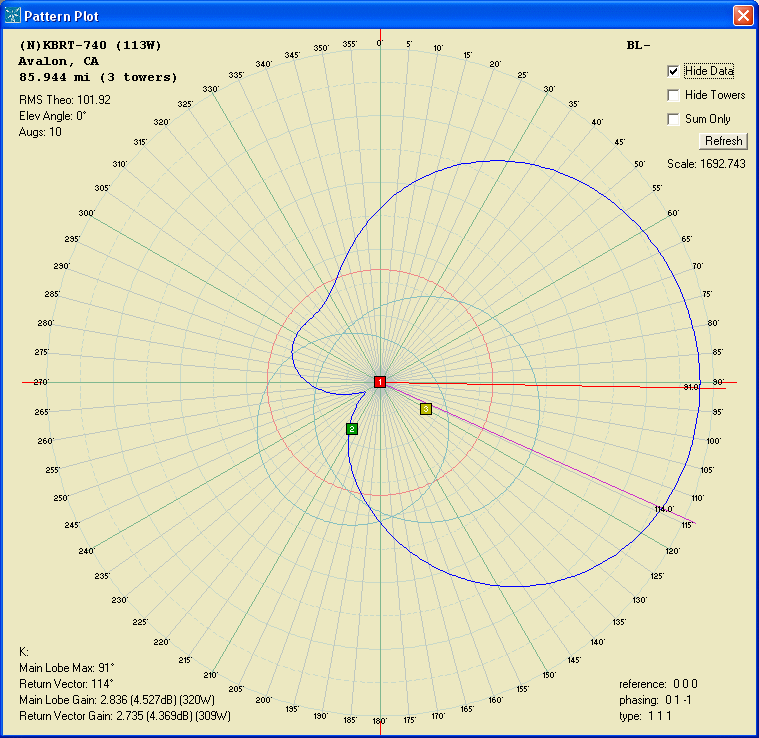
KBRT-740 "K-Brite", a 10KW station in Avalon, on Santa Catalina Island is only a mere 85 miles to the northwest of San Diego's KFMB. It has a three tower array in use both day and night, pointing its signal due east to cover the Los Angeles and Long Beach areas, a scant 26 miles away. KBRT drops its power to a gasping 113 watts at night. Being nearly "co-channel" with KFMB at only 20 KHz removed, inspecting KFMB's pattern plot reveals that that the broad cardoid lobe to the northwest pumps an astonishing effective radiated power of 95KW up a 294 degree vector right at KBRT on Catalina. With a salt water path the whole way, that should be a lot of signal.
The next station with a big signal at night and a smaller one during the day is WLIB-1190 running 10KW daytime and 30KW nighttime, in New York, NY. WLIB uses three towers for daytime broadcasting and four towers at night. Both patterns are generally towards the east, with the nighttime pattern more focused and skewed a little more to the southeast. During the day it competes with WBIS-1190, Annapolis, MD (10KW), and WSDE-1190, Cobleskill, NY (1KW). WLIB's daytime pattern exactly bisects these two challengers on a line right out into the Atlantic Ocean. At night, WLIB only has to contend with New Yorker WSDE, as the Annapolis station is off the air.
The station with the greatest power differential, day to night, is WLAN-1390, Lancaster, PA. They run a mere 18 watts daytime and 1100 watts nighttime, both to a single, omnidirectional tower. Their nighttime power is a remarkable 61.1 times more than their daytime power!
WLAN's main competitor is WZHF-1390 (5KW), in Arlington, VA, a mere 92 miles away to the south-southwest. How does an 1100 watt station co-exist with a 5KW station at night when they are only 92 miles apart? Examining the tower pattern plots, you will find that WLAN in Lancaster, PA is exactly in a deep notch of WZHF's nighttime pattern.
Shown are nighttime pattern plots for San Diego's KFMB-760 and Avalon's KBRT-740, generated by Radio Data MW.
"What stations actually are authorized with a HIGHER power at night than they are allowed in the daytime? I'll mention one - 760 KFMB San Diego, CA, about 7 miles from me. In the daytime they're only allowed a paltry 5KW omnidirectional, but at night they step up to 50KW."
An interesting question. And you mentioned signal patterns, all-important in the differences between daytime and nighttime mediumwave coverage.
I tweaked my database program Radio Data MW and came up with the following results:
73 US stations run higher power at night than during the day.
KFMB-760, your San Diego station, is the only one which runs 50KW at night and has a lower daytime power. KFMB uses one omnidirectional tower for daytime broadcasting. Power is set at 5KW during daytime broadcasting hours and 50KW at night. KFMB uses three towers at night to get that big 50KW signal out. But the pattern this time is pointed right out into the Pacific Ocean, to the southwest. San Diego's KFMB cardioid pattern has a deep, broad null at 60 degrees, nicely positioned for protection of Detroit Michigan's WJR-760 (50KW) and its western coverage area. Equally important, big gun KKZN-760, Thornton, CO (also 50KW), near Denver at 49 degrees is also protected, as well as a host of smaller US and Mexican stations.
KBRT-740 "K-Brite", a 10KW station in Avalon, on Santa Catalina Island is only a mere 85 miles to the northwest of San Diego's KFMB. It has a three tower array in use both day and night, pointing its signal due east to cover the Los Angeles and Long Beach areas, a scant 26 miles away. KBRT drops its power to a gasping 113 watts at night. Being nearly "co-channel" with KFMB at only 20 KHz removed, inspecting KFMB's pattern plot reveals that that the broad cardoid lobe to the northwest pumps an astonishing effective radiated power of 95KW up a 294 degree vector right at KBRT on Catalina. With a salt water path the whole way, that should be a lot of signal.
The next station with a big signal at night and a smaller one during the day is WLIB-1190 running 10KW daytime and 30KW nighttime, in New York, NY. WLIB uses three towers for daytime broadcasting and four towers at night. Both patterns are generally towards the east, with the nighttime pattern more focused and skewed a little more to the southeast. During the day it competes with WBIS-1190, Annapolis, MD (10KW), and WSDE-1190, Cobleskill, NY (1KW). WLIB's daytime pattern exactly bisects these two challengers on a line right out into the Atlantic Ocean. At night, WLIB only has to contend with New Yorker WSDE, as the Annapolis station is off the air.
The station with the greatest power differential, day to night, is WLAN-1390, Lancaster, PA. They run a mere 18 watts daytime and 1100 watts nighttime, both to a single, omnidirectional tower. Their nighttime power is a remarkable 61.1 times more than their daytime power!
WLAN's main competitor is WZHF-1390 (5KW), in Arlington, VA, a mere 92 miles away to the south-southwest. How does an 1100 watt station co-exist with a 5KW station at night when they are only 92 miles apart? Examining the tower pattern plots, you will find that WLAN in Lancaster, PA is exactly in a deep notch of WZHF's nighttime pattern.
Shown are nighttime pattern plots for San Diego's KFMB-760 and Avalon's KBRT-740, generated by Radio Data MW.
Tuesday, September 14, 2010
Winter DX Season 2010

Great mediumwave conditions were apparent three mornings ago (September 11). I'm an early riser, and at 6AM I'm usually on the way to the coffee shop DXing on the truck radio. Of course at that time of the morning it's still very dark out. The sun doesn't rise here until 6:40L. Tuning to 850 KHz at the top of the hour news, I caught a nice full ID from 50KW KOA-850, Denver, CO (1420 miles) at 0605L. The KOA radiator, a single tower located 30 miles to the southeast in Parker, CO, is a skyscraping 667.9 ft. tall, almost a full 5/8 wavelength in height. As advertised, KOA gets out to some 38 states, and probably more. KOA began broadcasting in 1924.
Back in the late 1970s and early 1980s, I lived a mere 10 miles southeast of this transmitter, out in the rolling eastern plains of Colorado near the town of Elizabeth. I worked in Denver, and would drive past this tower every day (or night) on the way to and from work, often seeing mule deer or prong-horned antelope. Coming from the east, a long hill descended down appropriately-named Hilltop Road, ending at Colorado Highway 83 which ran past the tower. Headed to work one night for the graveyard shift during a blizzard, at midnight I remember becoming disoriented in the whiteout and losing control while descending that hill, shooting straight across highway 83 and through a barbed wire fence, coming to rest in the field right next to the KOA tower. Ah, memories.
KOA is a tough catch here in western New York with nighttime interference from sports stations WKGE-850, Johnstown, PA (10KW), at 199 miles, and WKNR-850, Cleveland, OH (4.7KW), at 235 miles. Interestingly, on my cross country trip each year I start to hear KOA at night consistently once I get west of Ohio and into Indiana, and under the 1200 mile distance range. I find there's something brick-wallish about that 1200 mile distance in mediumwave DXing.

WWL-870, New Orleans, LA (50KW), 1136 miles, is also appearing almost daily on the 6AM trip. WWL has a two tower antenna array, oriented south-north with major lobes to the northwest, and northeast. The northeast lobe points directly at me. Each of WWL's towers is a full 1/2 wavelength tall. With 3.3 dB gain in my direction, it pumps a healthy effective radiated power of 106KW right up a pipeline to New York. WWL's transmitters are located approximately 2 miles southwest of Estelle, LA, in the Jean Lafitte Preserve, a wetlands. All that water undoubtedly helps too. WWL has been in operation since 1922, predating KOA by two years.
Apparently the winter DX season is upon us once again.
Subscribe to:
Posts (Atom)